
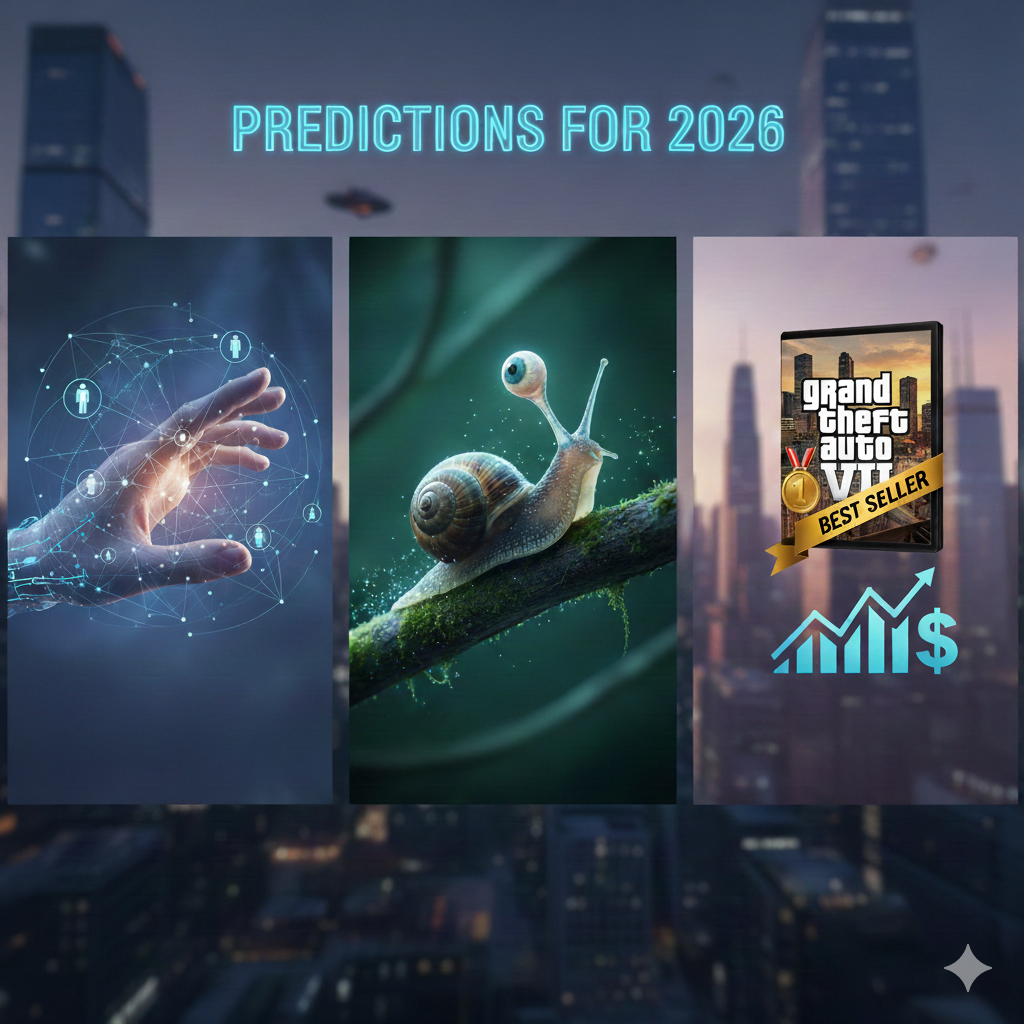
As 2026 approaches, we are entering a period where economic strategy, technological ambition, and philosophical uncertainty are no longer separate conversations. They are converging. The coming year will not be defined by isolated breakthroughs, but by how societies, institutions, and businesses learn to adapt to a faster, more complex world.
Below are three predictions that will shape 2026 — not as distant possibilities, but as forces already in motion.
1.Regenerative Medicine Breaks Its Psychological Barrier
or decades, regenerative medicine has been marketed as “promising” but distant. In 2026, that perception changes.
One of the most fascinating catalysts comes from an unlikely source: the golden apple snail.

Scientists recently observed that this small South American species can fully regenerate its eyes within roughly a month. Not repair them — regrow them. This includes complex structures such as the retina and optic nerves. While humans have gone to extraordinary lengths to restore sight — from artificial retinal implants to extreme procedures like tooth-in-eye surgery — true biological regeneration has remained elusive.
What makes this discovery significant is not just the biology, but the implication. The snail demonstrates that regeneration is not science fiction; it is a solvable biological process. For biotech firms and medical researchers, this shifts the conversation from if to how fast.
By 2026, we will see:
- Increased investment into regenerative biotech and tissue engineering
- Consulting demand around healthcare economics, longevity planning, and insurance reform
- Ethical debates intensifying around enhancement versus healing
Healthcare begins to move from maintenance to renewal — and that reframes how societies think about aging, productivity, and human potential itself.
A Moment of Reflection: When Predictions Start Becoming Patterns
It’s worth pausing here, because this isn’t the first time we’ve seen this convergence.
In 2025, many of the forecasts that once sounded ambitious quietly became reality: accelerated AI adoption across industries, a renewed focus on sovereign innovation, and businesses rethinking growth not as expansion at all costs, but as strategic positioning. What once felt speculative became operational.
That matters, because it tells us something important about 2026:
this is not a year for hesitation — it’s a year for intentional growth.
The organizations that thrive will be those willing to invest early, think laterally, and position themselves where innovation and demand naturally intersect. Growth in 2026 won’t come from chasing trends, but from understanding why those trends exist and aligning strategy accordingly. For companies willing to move with clarity and confidence, the coming year presents a rare opportunity to scale with purpose rather than pressure.
2. Artificial Intelligence Forces a Redefinition of Human Value
By 2026, AI will no longer be judged solely by productivity gains. The more uncomfortable question is now emerging:
What remains uniquely human when cognition itself becomes scalable?
Consultants are already seeing this shift. Organizations are no longer asking how AI can replace tasks, but how it reshapes roles. Strategy, ethics, interpretation, and meaning are becoming more valuable than execution.
As AI systems master analysis, prediction, and optimization, humans will increasingly be valued for:
- Judgment under uncertainty
- Moral and cultural reasoning
- Narrative-building and sense-making
In practical terms, this means companies will rethink leadership, education, and even hiring. The most valuable professionals won’t be those who know the most, but those who can connect meaning across complexity.
By 2026, AI won’t remove humanity from the equation — it will force humanity to define itself more clearly than ever before.
Wyoming Investor believes the future belongs to organizations that can think beyond today’s limits. Our consulting is built for leaders who don’t just want to survive change — they want to shape it. We offer a complimentary strategy session designed to explore your goals, challenges, and opportunities — no obligation, no sales pressure. Just a focused conversation to see where clarity, alignment, and growth can be unlocked.
Whether you’re navigating expansion, transformation, or long-term positioning, this is your opportunity to step back, gain perspective, and map what’s possible.
Schedule your free consultation and let’s begin shaping what comes next.
GTA 6 and the Rise of the Digital Economic Superstate
When Grand Theft Auto VI launches, it will not simply be a game release — it will be an economic event.
GTA already functions as a digital society, complete with economies, norms, power structures, and cultural influence. The next iteration is expected to expand this into something closer to a persistent virtual world.
Economically, the implications are enormous:
- Billions in direct revenue and secondary creator economies
- New models of digital labor and ownership
- Brand integrations that rival real-world advertising ecosystems
From a consulting perspective, GTA 6 becomes a live experiment in behavioral economics and digital sociology. It shows how people assign value, identity, and meaning in virtual environments — lessons increasingly relevant to real-world economies.
Culturally, it reflects a deeper truth: digital spaces are no longer escapes. They are extensions of reality, where influence, creativity, and capital all coexist.
Closing Thought: The Age of Convergence
2026 will not be remembered for a single invention or headline. It will be remembered as the moment where boundaries began to dissolve — between biology and technology, intelligence and identity, physical and digital worlds.
For leaders, investors, and institutions, the challenge is no longer predicting change. It’s learning how to move with it intentionally.
And perhaps the most important question of all remains quietly unresolved:
If we can rebuild bodies, replicate intelligence, and design entire worlds — what kind of future are we choosing to grow into?